


 On the Tzines hill which lies in the mountains
of south Thasos between Maries and Limenaria, 20 sites have been located
containing evidence of ochre mining in hematite deposits. Excavations
in some of them (T1, T2, T3 and T6) date the earliest mining activities
to the Upper Palaeolithic
Period (site T1).
On the Tzines hill which lies in the mountains
of south Thasos between Maries and Limenaria, 20 sites have been located
containing evidence of ochre mining in hematite deposits. Excavations
in some of them (T1, T2, T3 and T6) date the earliest mining activities
to the Upper Palaeolithic
Period (site T1).
Although there are traces of ochre mining in Africa from the Upper
Palaeolithic the mine in Thasos is among the earliest evidence in Europe
where there have been finds at Lovas in Hungary from the Lower Palaeolithic.
Ochre, the "gold" of the Palaeolithic, was used as a colouring substance
for rockengravings and body adornment as well as being regarded as a
symbol of blood and in consequence of life. Its early use by the anthropological
type Neanderthal
(Homo sapiens neanderthalensis) has been traced in burials of
the Middle Palaeolithic. However its systematic mining, various retouch
techniques and extensive use has also been traced to the Upper Palaeolithic.
The mining and processing (burning) of iron ochre to achieve a range
of colours from red to yellow is an acquisition of modern man Homo
sapiens sapiens).
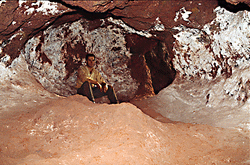
Exploring the sites T1, T2, T3 and T6 provided invaluable information
on the mining techniques and the tools used. The galeries explored were
4-7 m. long, 1,80-3 m. wide and 0,60-1 m. high. The mining was carried
out horizontally with successive knapping of the roof. The deposits
on the "floor" suggest the periodical exploitation of the mines. In
the central part of the galeries, where the mine workers more frequently
walked, the floor is worn.
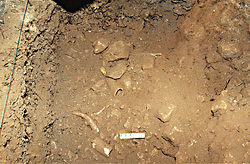
At the sides of the galeries there were waste fragments from the mining
and worn tools made of horn, bone and stone. Among them tools used for
mining but also artefacts suitable for the withdrawal and storage of
ochre have been identified.
For mining, hammer tools (unworked pebbles) and wedges (deer antlers
and bones of large animals) were used. Traces of horn wedges on the
walls and the roof of the gallery T1 have been observed. The horn points
were particularly rounded because of intensive use. Inside the mine
T2 no traces of horn wedges were found, indicating the exclusive application
of the percussion technique using lithic tools.
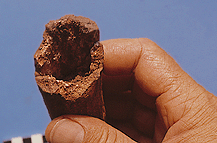
For the removal of the ochre (Cervus Elaphus), bone spatulas
were used and the ochre was then stored in hollow horns from which the
spongy material inside had been removed. Among the stone tools flakes
and blades made of opal stone and gree flint are included.
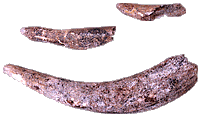
The bones and horns that were found in the galeries have helped to reconstruct the fauna of the region but also to date the use of the mines. The following animals have been identified: wild bull (Bos primigenius), wild ass (Equus cf. Hydrundinus), fallow deer (Dama dama), red deer (Cervus Elaphus), roe deer (Capreolus capreolus) and antelope Saiga (Saiga Tatarica).
The presence of large animals suggests that Thasos was still connected to the adjoining shore. The discovery, however, of a Saiga antelope (a steppe animal which disappeared at the end of the Pleistocene, when south Europe and the Balkans were covered with thickwood plantation) in the mine T1, is clear evidence that the area was exploited 10,000 years ago. The radiocarbon dating of the collagen from a bone tool provided the most accurate date for the mine T1 to the Upper Palaeolithic (20,300 BP).
The ochre mines were traced on Thasos in 1956 but their detailed investigation was undertaken in 1981, 1982, 1983 and 1993 by the 18th Ephorate of Prehistoric and Classical Antiquities in Kavala, the Institute of Geological and Mine Research in Xanthi and the Max Plank Institut Heidelberg.