


 The cave at Piges tou Angiti, also known as Maara cave,
is situated in east Macedonia to the north of the Drama basin, close
to the village Angitis (Kokkinogeia Commune). It lies at the foot of
Mount Falakro and is the subterranean link for the Neurokopi and Drama
plains. The cave has taken the name of Angitis as the tributary of Strymon
Angitis halts the subterranean flow at the natural entrance of the cave
from where it continues its flow southwards overland.
The cave at Piges tou Angiti, also known as Maara cave,
is situated in east Macedonia to the north of the Drama basin, close
to the village Angitis (Kokkinogeia Commune). It lies at the foot of
Mount Falakro and is the subterranean link for the Neurokopi and Drama
plains. The cave has taken the name of Angitis as the tributary of Strymon
Angitis halts the subterranean flow at the natural entrance of the cave
from where it continues its flow southwards overland.
In the trial section (4,0Χ1,5 metres), close to the artificial entrance, in layers with thickness of about 2,6 metres, numerous pieces of palaeontological material (animal bones) and a relatively small amount of lithic tools of the Middle Palaeolithic, ca. ±30,000 years BP, were unearthed.
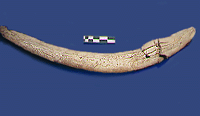
Among the palaeontological material there were at least 2000 small and
large animal fragments, entire bones and parts of animal skeletons.
They were mostly omnivore animals such as cervidae, equidae (horse),
rhinocrotidae (woolly rhinoceros, one-horned rhinoceros) and elephantidae
(mammoth), while some carnivores such as ursidae were also unearthed.
Their deposition (taphonomy) indicates that they were not common food
remains, such as those discovered at the caves of the Middle Palaeolithic
in "Lakonis" and "Kalamakia"
in Mani.
Among the animal bones, 104 artefacts were brought to light shaped on quartz, and less often, flint flakes. These artefacts are typical of the Mousterien stone industry and date to the advanced stage of the Middle Palaeolithic which included single-cut and double-cut rasps, endscrapers, denticulates and points. Most of them were finished tools whereas a few were products of a secondary process, that is finished tools already at the site were secondary worked on only when necessary. Nevertheless, the raw material was not found close to the palaenvironment of the cave; quartz has been traced in the Drama basin, and volcanic rock in the northeast part of Rhodope.

From the palaeontological and in general archaeological material in
combination with the location (passage) of the cave, we can infer that
it was used as a passage for hunter-gatherers and served for collecting,
killing and perhaps partially cutting the animals. The hard layer of
the cave, where the bones were solidified, unfortunately demanded their
extraction from the soil with mechanical scrub methods (such as special
knives, chisel-like tools and a small vibration pen)
which destroyed every trace of stone tools on the bones of animals.
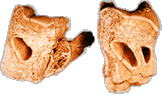 The polymorphism of the bone material from Piges tou Angiti renders
it a unique find as it provides the first indications on the fauna in
Macedonia during the Middle Palaeolithic.
The polymorphism of the bone material from Piges tou Angiti renders
it a unique find as it provides the first indications on the fauna in
Macedonia during the Middle Palaeolithic.
The Ephorate of Palaeoanthropology-Speleology has conducted the investigation at the Piges tou Angiti Cave since 1993.