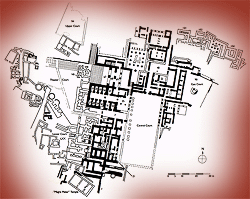
 Phaistos is situated in the middle of the fertile Mesara valley.
The palace is considered to be the most aesthetically rounded of all Minoan palaces,
if not of all the palaces in the Middle East too. It is built on a levelled hill,
which distinguishes it from the other palaces. The reason it
was built in this position does not seem to be the need for safety but the prestige
which attached to the palace on account of the panoramic view of the valley and the sacred
peak of Mt. Ida. Phaistos is situated in the middle of the fertile Mesara valley.
The palace is considered to be the most aesthetically rounded of all Minoan palaces,
if not of all the palaces in the Middle East too. It is built on a levelled hill,
which distinguishes it from the other palaces. The reason it
was built in this position does not seem to be the need for safety but the prestige
which attached to the palace on account of the panoramic view of the valley and the sacred
peak of Mt. Ida.
The first palace of Phaistos was built about 2000 BC following a single architectural plan.
The remains of the first palace are better preserved than the those of the first palace of
Knossos. Judging from the installation as a whole, the staircases, the fallen building and
decorative materials we can assume that there was a second floor,
and possibly a third too.
|
| In the west of the palace, two courts communicating with each other
via wide stairs constitute the theatral area of the palace.
From that point a very wide staircase
led to successive antechambers with colonnades and a light-well
and then to the central court or to a peristyle area. |
| Between the central entrance and the central court were
rows of magazines which had a common antechamber.
In the north side of the central court was
a smaller paved court and a narrow walkway, and roofed court in the west.
The apartments of the entrance to the central court were paved and had a second storey.
East of this was a polythyron. Inside the central court there were probably
flagstaffs, similar to those depicted on the relief representation of the rhyton of Zakros,
while in the centre of the east court there was a kiln.
|
|
In the north wing of the palace were the royal apartments
which were accessible by a staircase which started from a peristyle court.
In the east wing, similar disposition to the royal apartments which were appropriate for
habitation in wintertime is observed. This is where the large room which had
its own bathroom and roofed balcony was situated.
It is conventionally usually named the room of the queen.
The other rooms of the east wing are probably destined for the staff, as in Knossos and Mallia,
and they had their own, independent entrance.
|
|
A row of columns in the west wing indicates the existence of a large room facing the south.
The gypsum revetment of the walls and floor as well as the niches in three of the walls
are signs of the function of a very important room. Two other rooms were used for cult
activities while two areas with individual bathrooms and one room have been defined as
guest rooms. |