 |
| Crete is an area where the continuity of the Mycenaean tradition through the Dark Age
is best observed. In all probability, the movement of populations from the Peloponnese
to Crete and Cyprus may have contributed to the maintenance of the know-how
of utilitarian arts, such as pottery. The most important centres remained the same
from the previous period: Knossos, Phaestos and Gortys. In the Protogeometric
phase (1050-900 BC), the Cretan potters seem to have been familiar with the Attic decorative models,
applying them sometimes to shapes of a long tradition, as in the case of stirrup jars.
On the other hand, bird-shaped vases demonstrate a Cypriot influence, and
free renderings of hunting and battle scenes are not rare. |
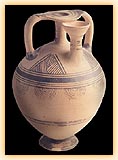
Our knowledge of the first half of the 9th century BC is limited, whilst in the second half
a style emerges that has been called Protogeometric style II. In reality, however, its features
are orientalizing dominated by
cable, spiral and arc motifs. Even though relations with Cyprus are
testified to during this period, its source of inspiration must probably be sought in Syrian
metalwork, the products of which were imported and imitated on the island. |
| In the 8th century BC, the production of the workshop of Knossos is notable. The frequency of
pictorial representations decreases and the most important vase shapes are: the pithos with straight-sided
walls, the pithos with an oval body and three loops at the base forming a tripod, and the so-called 'Cypriot flask' (lekythos).
This is a kind of oinochoe with spherical body and high neck, a particularly popular shape in Cyprus.
|