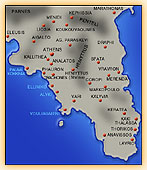
 Attica and Euboea were two of the regions which preserved the most closely united
masses of the Mycenaean population and had not suffered destructions
and desolations as other regions had towards the end of the Mycenaean age. The
Dorians never managed to conquer Attica, which continued throughout historical
times to be inhabited by Ionians. According to Attic tradition
which refers to this habitation, Ion -who divided the Ionians of Attica into tribes:
the Geleontes, Aigikoreis, Argadeis and Hopletes- was considered the leader of the Athenians.
His son, Xuthus, was appointed as Polemarch by the Athenians after his victory over the Thracians
Attica and Euboea were two of the regions which preserved the most closely united
masses of the Mycenaean population and had not suffered destructions
and desolations as other regions had towards the end of the Mycenaean age. The
Dorians never managed to conquer Attica, which continued throughout historical
times to be inhabited by Ionians. According to Attic tradition
which refers to this habitation, Ion -who divided the Ionians of Attica into tribes:
the Geleontes, Aigikoreis, Argadeis and Hopletes- was considered the leader of the Athenians.
His son, Xuthus, was appointed as Polemarch by the Athenians after his victory over the Thracians |
