 The Romans were more inclined than the Hellenes to deify and worship abstract notions like Concord (Concordia, Fortune (Fortuna), Wealth (Ops), Peace (Pax), Reverence (Pietas), Providence (Providentia), Health (Salus), Hope (Spes), and Victory (Victoria) - corresponding to the Greek Homonoia, Tyche, Aphthonia, Eirene,, Eusebeia, Pronoia, Soteria, Elpis, and Nike respectively. 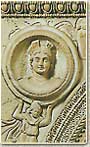
In the Imperial Age, the worship of these notions was exploited as politically useful, and coins circulating throughout the Empire often bore the bust of the emperor on the obverse with one of the above abstract notions represented as a female divinity on the reverse. They were recognizable from their habitual attributes: a wheel (or helm) for Fortuna; the cornucopia for both Ops and Pax; and winged Victoria is shown crowning the emperor. This cult was widely observed in the Roman empire: in many cities temples were built, statues dedicated and sacrifices made at altars in their honour. These were cult acts combining to attest Roman subjects' collective desire for prosperity and happiness and the firm belief that a strong Rome would secure it for them. |
