 In the half-century after the assassination
of the last of the Severan emperors, Severus Alexander,
in AD 235, Rome was to know at least twenty emperors
and several other 'hopefuls' who laid claim to the Roman
throne. The Empire's territorial and economic unity came
under threat, and the army stationed in the various
provinces had now become the main regulator of the Roman
constitution.
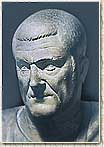 The case of Maximinus Thrax (AD 235-238)
is typical of the dominant political and military
conditions of that time. Though but a simple soldier,
Maximinus managed, thanks to his impressive military
successes at the expense of the German tribes, to climb
all the rungs of the ladder and seize the topmost office
of the Empire. The case of Maximinus Thrax (AD 235-238)
is typical of the dominant political and military
conditions of that time. Though but a simple soldier,
Maximinus managed, thanks to his impressive military
successes at the expense of the German tribes, to climb
all the rungs of the ladder and seize the topmost office
of the Empire.
The new 'Illyrian' dynasty did their best to deal with
this crisis in all departments of the Empire. Their main
concern was how to rein back enemy raids across the
Empire's frontiers and how to reinforce the unity of the
state. Despite their efforts to compromise with the
Senate's position and not to meddle with its economic
interests, their period of power was one rocked by
continuous assassinations of emperors.
|
