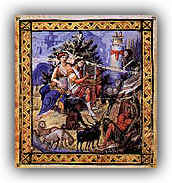
 the starting point of the period as the year 843, when the icons were finally restored. A term frequently used for this period is the Macedonian Renaissance. The use of this term, however, should not be confused with the notion of the Renaissance as it is known in the West, which
took place under totally different conditions and whose aim was to study and observe reality. Byzantine art, on the contrary, aimed, in its use of classical
forms, to convey a transcendental character. Additionally, there is a fundamental difference in the Byzantine and Renaissance
approach to classical models.
the starting point of the period as the year 843, when the icons were finally restored. A term frequently used for this period is the Macedonian Renaissance. The use of this term, however, should not be confused with the notion of the Renaissance as it is known in the West, which
took place under totally different conditions and whose aim was to study and observe reality. Byzantine art, on the contrary, aimed, in its use of classical
forms, to convey a transcendental character. Additionally, there is a fundamental difference in the Byzantine and Renaissance
approach to classical models. The term Macedonian Renaissance was coined to emphasize the revival and prosperity of Byzantium during the 10th and the 11th centuries. It was the framework within which within letters and the arts flourished.
The period after 843 was important both for the reorganization and establishment of a new iconographic programme and the spread of the cross-in-square church. The paucity of surviving examples of pictures and mosaics from the period is counter-balanced by the many manuscripts that have been preserved (in excellent condition) from Imperial and Patriarchal sources. At the same time, metal objects, often decorated with precious stones, and finely-carved ivories, reflect the undoubted economic and cultural strength of Byzantium in this period.