|
Phevos
and Athena: The Mascot of the Olympic Games 2004
Already
from the moment Athens assumed the organization of the 28th
Olympic Games 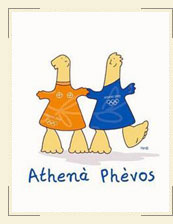 there
were discussions regarding what would be the mascot of the
Games. The general view was that it should have a "Greek
scent", but also embody, in a way, the Olympic ideals.
After a competition, Phevos and Athena were selected, two
figures inspired by Greek antiquity. More specifically they
were a combination of types of ancient Greek dolls, with their
closest model the one of the bell-shaped doll. These dolls
were called "daidala" and, besides being toys for
children, they were also used religiously. there
were discussions regarding what would be the mascot of the
Games. The general view was that it should have a "Greek
scent", but also embody, in a way, the Olympic ideals.
After a competition, Phevos and Athena were selected, two
figures inspired by Greek antiquity. More specifically they
were a combination of types of ancient Greek dolls, with their
closest model the one of the bell-shaped doll. These dolls
were called "daidala" and, besides being toys for
children, they were also used religiously.
We should note that it was the first time that the mascot
of the Games represented human beings and not personified
animals. In this way the anthropocentric character of the
Games was emphasized. The names selected were directly related
with Greek mythology and have intense symbolic character.
In ancient antiquity Phevos-Apollo was considered the god
of light and music, while his sister Athena, goddess of wisdom
and protector of Athens.
Phevos and Athena depict two children -brother and sister-
making in this way an indirect reference to brotherhood, that
should relate all athletes, but also all people in the world.
Besides, childhood and the children's participation in the
game for the sake of the joy of the game and not necessarily
for victory alone is a direct reference to the Olympic ideal,
where the important thing is participation itself. |